



Cookie Notice
 Back to all news
How to Choose the Right Brake Pads for Your Car — A Complete Guide for 2026
Brake pads are one of the most safety-critical components on your vehicle — yet they're also one of the most confusing to shop for. Walk into any parts store (or browse Spareza's catalog of 2M+ parts) and you'll find ceramic, semi-metallic, organic, and OEM options, all at very different price points.
So how do you know which one is right for your car?
Brake pads are one of the most safety-critical components on your vehicle — yet they're also one of the most confusing to shop for. Walk into any parts store (or browse Spareza's catalog of 2M+ parts) and you'll find ceramic, semi-metallic, organic, and OEM options, all at very different price points.
So how do you know which one is right for your car?
This guide breaks down everything you need to know: the different types of brake pads, when to replace them, which brands are worth trusting, and how to find the exact part number for your vehicle.
The 3 Main Types of Brake Pads
1. Ceramic Brake Pads
Ceramic pads are made from dense ceramic fibers bonded with copper. They're the most popular choice for everyday passenger vehicles in Europe and North America.
Best for: Daily driving, city traffic, highway commuting
Key advantages:
- Very quiet — minimal brake squeal
- Low dust — your wheels stay cleaner
- Consistent performance in a wide temperature range
- Long lifespan (typically 50,000–70,000 km)
Drawbacks: Not ideal for heavy towing or track use, and tend to cost more than organic pads.
Popular brands: Brembo, TRW, Ferodo, ATE
2. Semi-Metallic Brake Pads
Semi-metallic pads contain 30–65% metal (steel, copper, iron), which gives them excellent heat dissipation and stopping power.
Best for: Heavier vehicles, towing, spirited driving, vans
Key advantages:
- Superior stopping power, especially under heavy load
- Excellent performance at high temperatures
- More affordable than ceramic
Drawbacks: More brake dust, can be noisier, and may wear rotors faster than ceramic pads.
Popular brands: Bosch, VALEO, Zimmermann, LPR
3. Organic (NAO) Brake Pads
Organic pads are made from materials like rubber, fiber, and glass — bonded together with resin. They were the standard before ceramic pads became widespread.
Best for: Light vehicles, low-speed urban driving, budget-conscious drivers
Key advantages:
- Quietest of all three types
- Softest on rotors — less wear
- Lowest price point
Drawbacks: Shorter lifespan, worse performance in wet conditions, more dust, and fade faster under repeated hard braking.
How to Know When Your Brake Pads Need Replacing
Most brake pads have a wear indicator — a small metal tab that produces a high-pitched squeal when the pad is worn down. But don't wait for the squeal. Check these signs:
- Squealing or squeaking when braking — the indicator is touching the rotor
- Grinding or metal-on-metal sound — the pad is completely worn, rotor damage likely
- Increased stopping distance — reduced braking efficiency
- Brake warning light on your dashboard
- Vibration through the brake pedal — uneven wear or warped rotors
- Pad thickness below 3mm — visible through the wheel spokes
As a general rule: replace brake pads every 25,000–70,000 km depending on driving style, vehicle weight, and pad type.
OEM vs Aftermarket Brake Pads — Which Should You Choose?
This is the most common question we hear at Spareza.
OEM pads (Original Equipment Manufacturer) are made by the same supplier that produced your car's original brakes. They're guaranteed to fit perfectly and match the original performance spec.
Aftermarket pads from trusted brands like Brembo, Bosch, or TRW often match — or even exceed — OEM performance, at a significantly lower price. In fact, many OEM pads are manufactured by the same companies that produce aftermarket parts.
Our recommendation:
For most drivers, a quality aftermarket pad from a reputable brand (Brembo, Bosch, VALEO, Ferodo) is the smart choice. You get the same or better performance, for 30–50% less than dealer prices.
If you drive a performance vehicle or have specific warranty requirements, OEM is worth the premium.
How to Find the Right Brake Pad Part Number
Getting the wrong brake pads is a frustrating and costly mistake. Here's how to get it right every time:
Option 1: Use your VIN number
Your Vehicle Identification Number (17 digits, found on the dashboard or door frame) uniquely identifies your car's exact specification. At Spareza, you can search by VIN to get a precise match.
Option 2: Search by vehicle make, model, year, and engine
For example: BMW 3 Series (F30), 2015, 320d 2.0 diesel — front brake pads.
Option 3: Use the OEM part number
If you have the original part number from your dealer or current pads, you can cross-reference it to find compatible aftermarket options. Spareza's catalog covers cross-references for all major brands.
Pro tip: Always replace brake pads in axle pairs (both front or both rear). Replacing only one side creates uneven braking and is a safety risk.
Top Brake Pad Brands Available at Spareza
| Brand | Type | Best Known For |
|---|---|---|
| Brembo | Ceramic & Semi-metallic | Performance cars, premium OE supplier |
| Bosch | Ceramic & Semi-metallic | Reliability, wide compatibility |
| TRW | Ceramic & Semi-metallic | European vehicles, OE quality |
| Ferodo | All types | Racing heritage, consistent performance |
| VALEO | Organic & Ceramic | French and European vehicles |
| ATE | Ceramic | German vehicles, BMW/Mercedes specialist |
| Zimmermann | Semi-metallic | Coated rotors, complete brake kits |
Frequently Asked Questions
Can I mix ceramic and semi-metallic pads?
No. Always use the same type on both wheels of the same axle. Mixing types causes uneven braking and can create dangerous handling.
Do I need to replace rotors when replacing pads?
Not always. If your rotors are above the minimum thickness (stamped on the rotor edge) and have no deep grooves or warping, pads alone are fine. If rotors are worn below spec — replace them together with pads.
How long does brake pad replacement take?
For a mechanic: 1–2 hours per axle. For a DIY job with the right tools: 2–3 hours.
Are more expensive brake pads always better?
Not necessarily. For most everyday driving, a mid-range ceramic pad from Bosch or TRW will outperform an expensive performance pad that's designed for high-temperature track use.
Find the Right Brake Pads for Your Vehicle
Spareza carries brake pads from all major brands — Brembo, Bosch, TRW, Ferodo, VALEO, ATE, and more — with worldwide delivery.
Search by your vehicle or part number to find the exact match for your car.
Published by The Auto Hub — Spareza's guide to smarter parts buying.
Last updated: April 2026
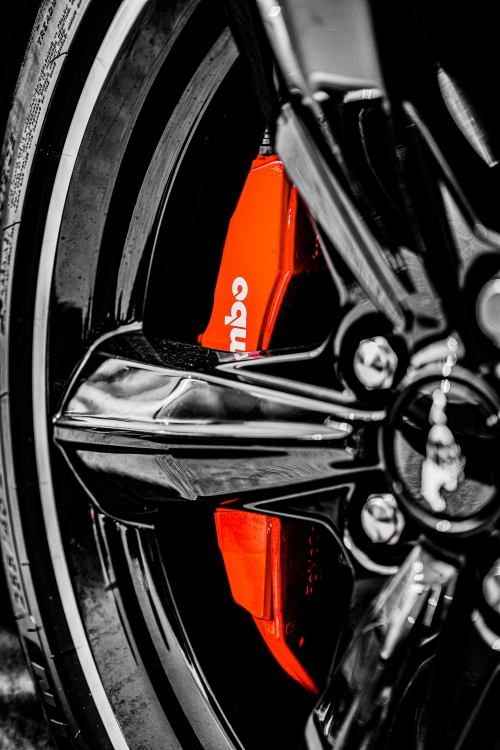
Photo by atelierbyvineeth ... on Unsplash